
Searchable is one of the newer tools to pop up in the AI visibility space. At first glance, the tool’s interface looks similar to Peec AI. What makes it stand out, however, isn’t its clean interface; it's how many features it packs at an affordable price.
But how do those features actually hold up? I tested all of Searchable’s features to find how it performs as an AI visibility tool. Here’s what the platform does well, where it falls short, and when you might need a more thorough AI visibility provider (like Profound). I’m using Modash as an example in this article.
Long story short: Searchable is a strong starting point, but you will (likely) outgrow it fast
Searchable is a solid entry point for teams that want an accessible, affordable way to start tracking their brand’s AI visibility. It’s easy to use, covers a wide feature surface—tracking, content, audits, and an AI agent—and its agency setup makes it a genuinely appealing option for small shops adding Answer Engine Optimization (AEO) to their services.
But if you need deep data to build a serious, ongoing AEO strategy on, Searchable doesn’t go far enough. There’s no real prompt volume data, no persona segmentation, and no way to run workflows at scale—limitations you’ll bump into quickly as your AI visibility efforts mature.
Here’s a quick summary of the pros and cons of Searchable:
Searchable: What it does right
I tested Searchable across its core features—visibility tracking, prompt research, content generation, and its AI agent. For a tool that’s only been around since late 2025, it does a surprising amount well.
Searchable’s AI agent helps you chat with your AI visibility data
Most AI visibility tools give you dashboards and leave you to interpret them. But Searchable has an AI agent that allows you to chat with your AI visibility data—ask anything about your visibility, prompts, content, or site health, and it pulls the answer from your own workspace data in plain language. Ask it why you’re not showing up for a certain prompt, or what to fix first, and you get an answer rather than another chart to decode.
It also takes action across the workspace (i.e., generating content, running analysis, exporting reports), and with the recent addition of Skills (more on them later), you can save a workflow and rerun it, so a one-off request becomes a repeatable tool for your team.
That said, it’s not perfect (yet?). While testing, I noticed the response was rather slow, and the tool was often buggy. Something worth remembering is it only works while the chat window is open—if you navigate away mid-task, it stops rather than finishing in the background.
Key takeaway: Searchable’s agent turns your visibility data into plain-language answers and repeatable workflows. Just expect some lag, and keep the window open while it works.
Searchable covers a wide range of AI engines (but only on the Custom plan)
Searchable can track a broad set of answer engines, including ChatGPT, Google AI Overviews, Perplexity, Claude, Microsoft Copilot, Grok, and DeepSeek. If your buyers are spread across several assistants, that breadth is important, and it’s a point in Searchable’s favor that it covers the major ones at all.
The catch is that this full coverage only comes together on the Custom plan. Every standard tier tracks just three engines out of the box, with the rest sold as add-ons. So “wide coverage” is true, but it’s not truly affordable or better priced compared to other tools in the market.
Key takeaway: Searchable supports most of the major AI engines, which is great if your audience is fragmented across assistants—just know that tracking all of them requires the highest tier Custom plan.
Searchable is beginner-friendly and easy to navigate
Searchable is one of those tools you can sign into and start using without a manual. The data is clean and readable, the navigation between features is intuitive, and you don’t need to understand the mechanics of AEO to get value from day one.
For a team just starting to take AI visibility seriously, that low barrier to entry is nothing to scoff at—you’re not paying for a consultant to interpret the dashboard for you.
Part of why it feels so approachable is that there's less depth under the hood than a specialist tool like Profound, but I'll get into where that thinness starts to hurt later. For getting off the ground, the simplicity is a nice bonus.
Key takeaway: Searchable is accessible and easy to use out of the box, which makes it a comfortable entry point for teams new to AI visibility.
Searchable has a well-thought-out agency pricing model
Searchable’s agency offerings are clearly built by people who understand agency workflows. You have “Pitch Workspaces,” which are time-boxed environments with their own prompt budget for running AI visibility audits on prospects. These have additional prompts in addition to your tracked prompts.
So if you’re pitching a new client your AEO services, and you aren’t sure whether they’ll sign a contract with you yet, you can use these plans to ensure pitching useful prompts never eats into the capacity you’ve reserved for paying clients.
The plans aren’t cheap though—you need to pay $250/month for five projects. And those agency tiers still track only the three base engines out of the box, so if your clients care about Claude or Copilot, there are additional add-on costs on top of the sticker price.
Key takeaway: Searchable’s agency plans—starting at $250/month with a genuinely useful pitch-workspace system—make it a strong fit for small and growing agencies. Just factor in that broader engine coverage still costs extra.
Searchable: What needs improvement
Searchable gets a lot right, and it’s a natural first AEO tool to turn to. But the more I pushed it toward serious, ongoing AEO work, the more I ran into the same wall: the data is broad but shallow, and the tooling thins out exactly where a maturing strategy needs it to deepen.
Searchable doesn’t give you any prompt volume data
Searchable can’t tell you which prompts are worth caring about—which has been a problem for a majority of AI visibility tools. It shows a “volume” indicator next to proposed prompts, but it’s a small bar rather than a number, and it’s unclear how this number is calculated (or why the proposed prompts are recommended).
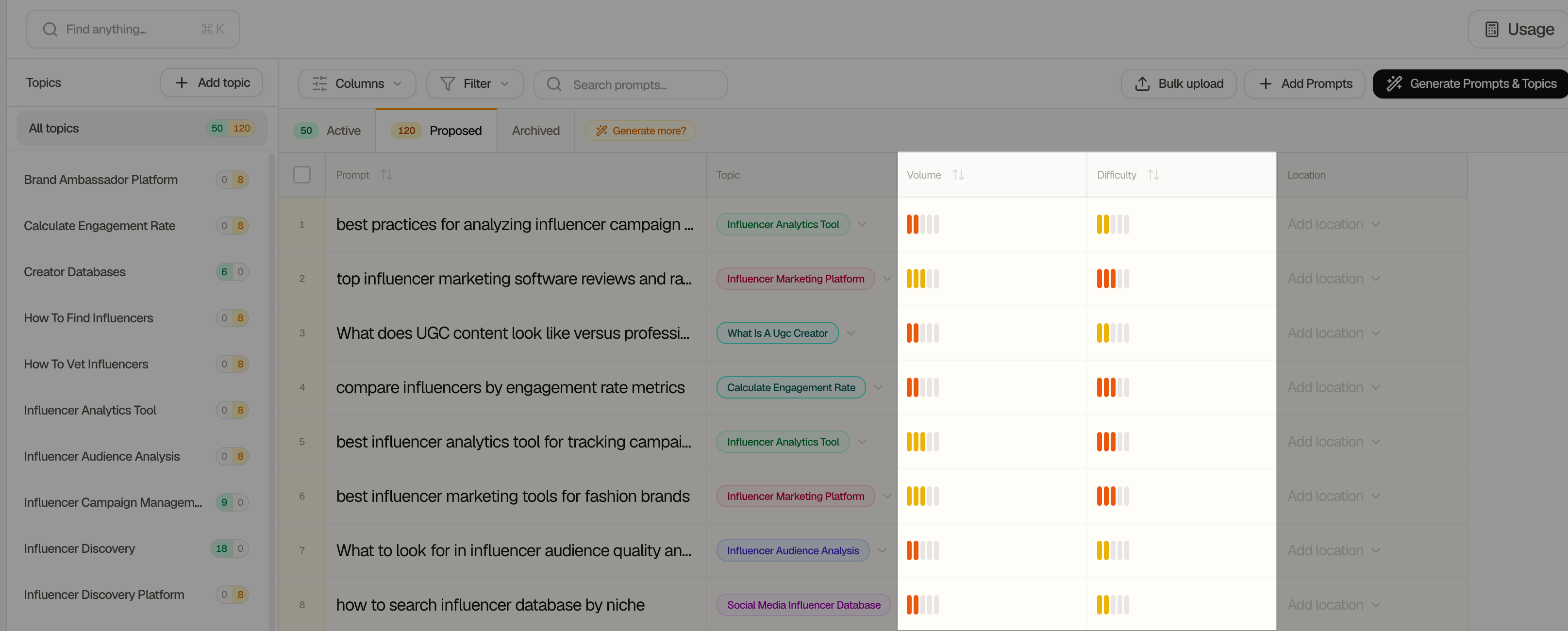
Searchable surfaces proposed prompts with color-coded volume and difficulty bars rather than actual figures, so there's no clear way to tell which prompts carry real demand in AI answers.
From testing, it reads like a keyword-style estimate borrowed from traditional SEO tooling—not a measure of real demand in AI answers. The “difficulty” score sitting next to it has the same SEO-coded feel.
Choosing the right prompts is the foundation of an AEO program. If you can’t tell which questions your buyers actually ask AI tools, you’re optimizing on guesswork. Profound built Prompt Volumes specifically to solve this—it estimates AI search volume from a dataset of 1.9+ billion real user prompts, updated weekly.
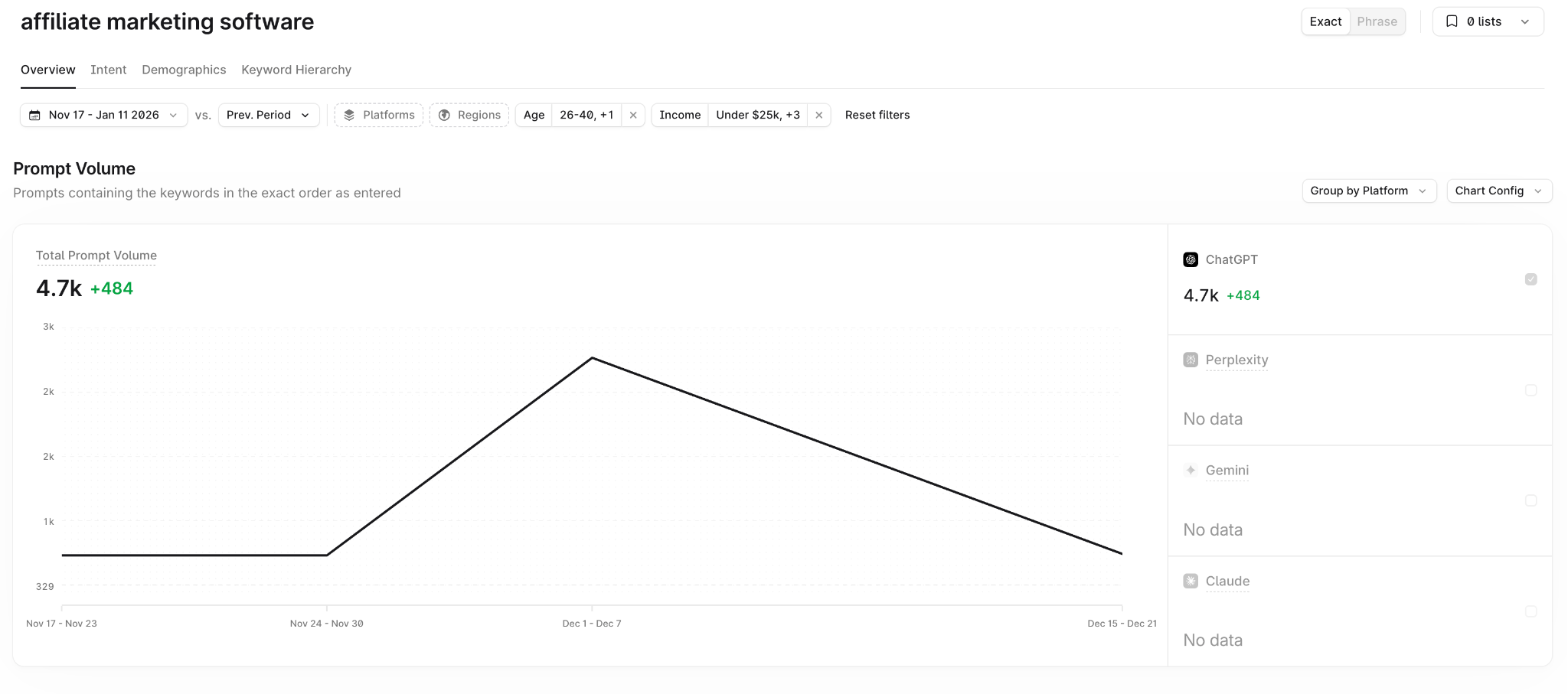
Profound's Prompt Volumes estimates real AI search demand — here 4,700 prompts for "affiliate marketing software," split by platform — drawn from a dataset of 1.9+ billion user prompts and updated weekly.
And if a keyword isn’t in its database, it calculates the volume in real time rather than showing you a blank. That’s the difference between knowing what to track and hoping you picked right.
Key takeaway: Searchable shows a volume score, but it’s an undisclosed estimate rather than measured AI demand—so you can’t reliably tell which prompts are worth tracking. Profound’s Prompt Volumes gives you actual data to prioritize with.
Searchable doesn’t allow you to compare LLMs side by side
Searchable lets you look at your visibility on each engine, but only one at a time. There’s no view that puts two models next to each other so you can see, at a glance, where you’re strong on ChatGPT but invisible on Perplexity.
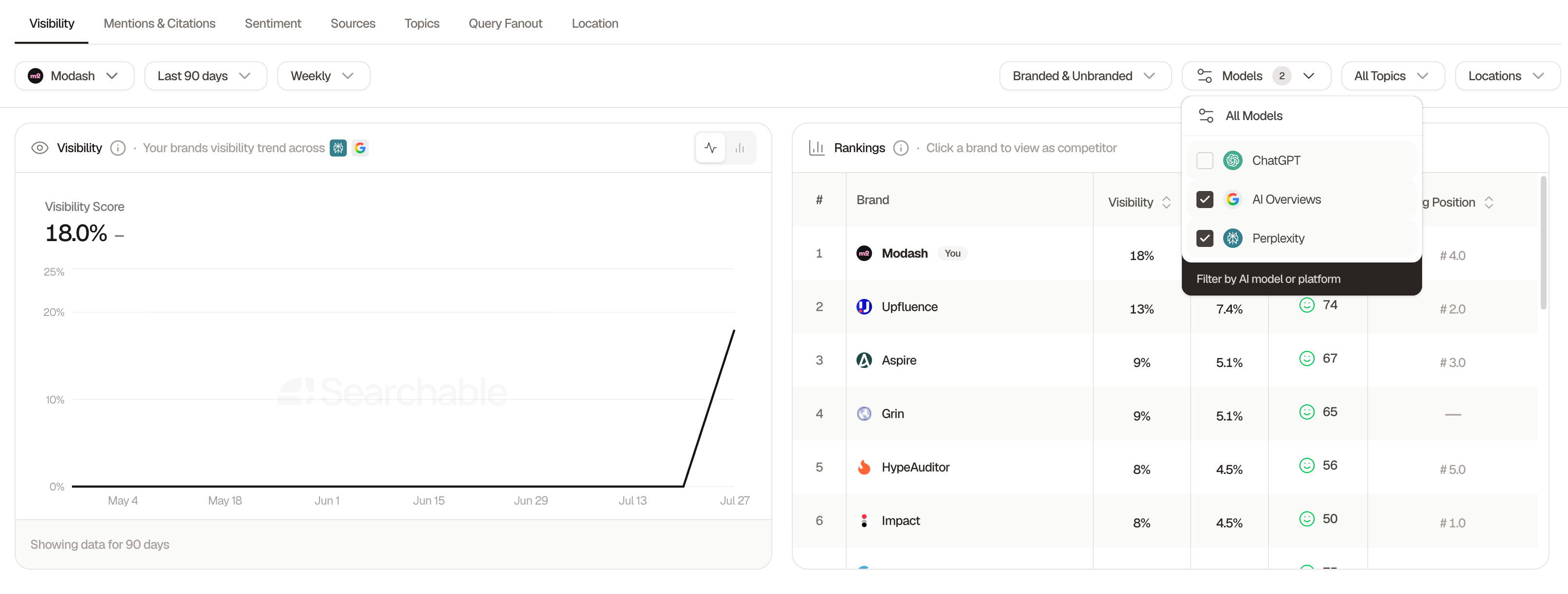
Searchable shows visibility rankings for a single engine at a time; the model filter toggles between ChatGPT, AI Overviews, and Perplexity but has no side-by-side view.
I could select each engine individually and read its numbers, but I couldn’t get a single dashboard to compare performance across them—which is exactly the comparison you need when you're deciding where to focus.
For a tool whose whole premise is multi-engine visibility, the lack of a side-by-side view is a massive gap. Profound treats platform-by-platform comparison as a core part of the interface, with a dedicated way to dissect the share of voice, sentiment, accuracy, and position across engines in one place.
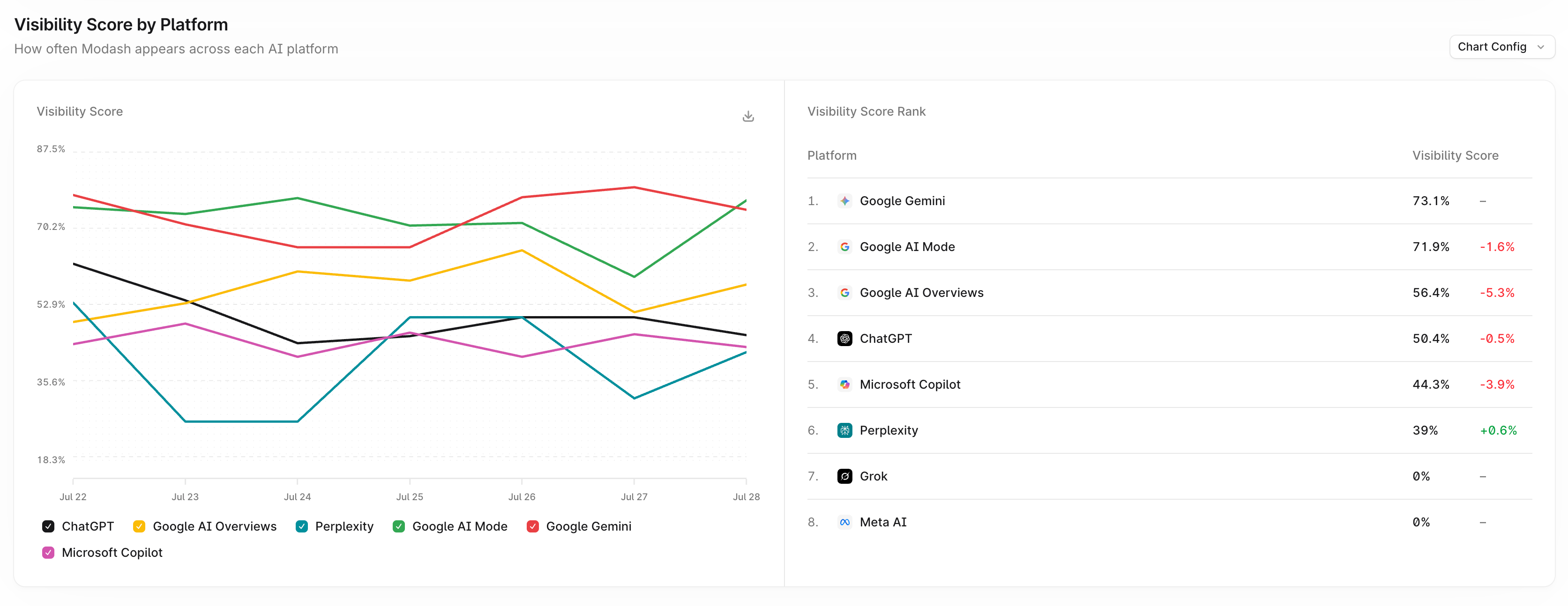
Profound compares visibility across every engine in a single dashboard, ranking Visibility Score by platform so you can see where you're strong and where you're invisible at a glance.
Key takeaway: Searchable makes you check engines one at a time, with no side-by-side comparison—a frustrating limitation for a multi-engine tool.
In Searchable, you can’t segment your AI visibility data by personas
Searchable segments your data by location, which is useful, but it stops there. There’s no way to slice your visibility by buyer persona, so if you want different AI visibility data points for a technical decision maker vs. the end user, you can’t do that in Searchable.
For a brand with one flavor of customer, this drawback isn’t a dealbreaker. But if you’re serving a varied or global ICP with genuinely different buyer types, the lack of personas can lead to a lot of manual work.
Profound treats personas as a first-class dimension: you can build customer segments and slice your visibility data by each one to see whether you’re winning with the audiences that drive revenue rather than just winning on average.
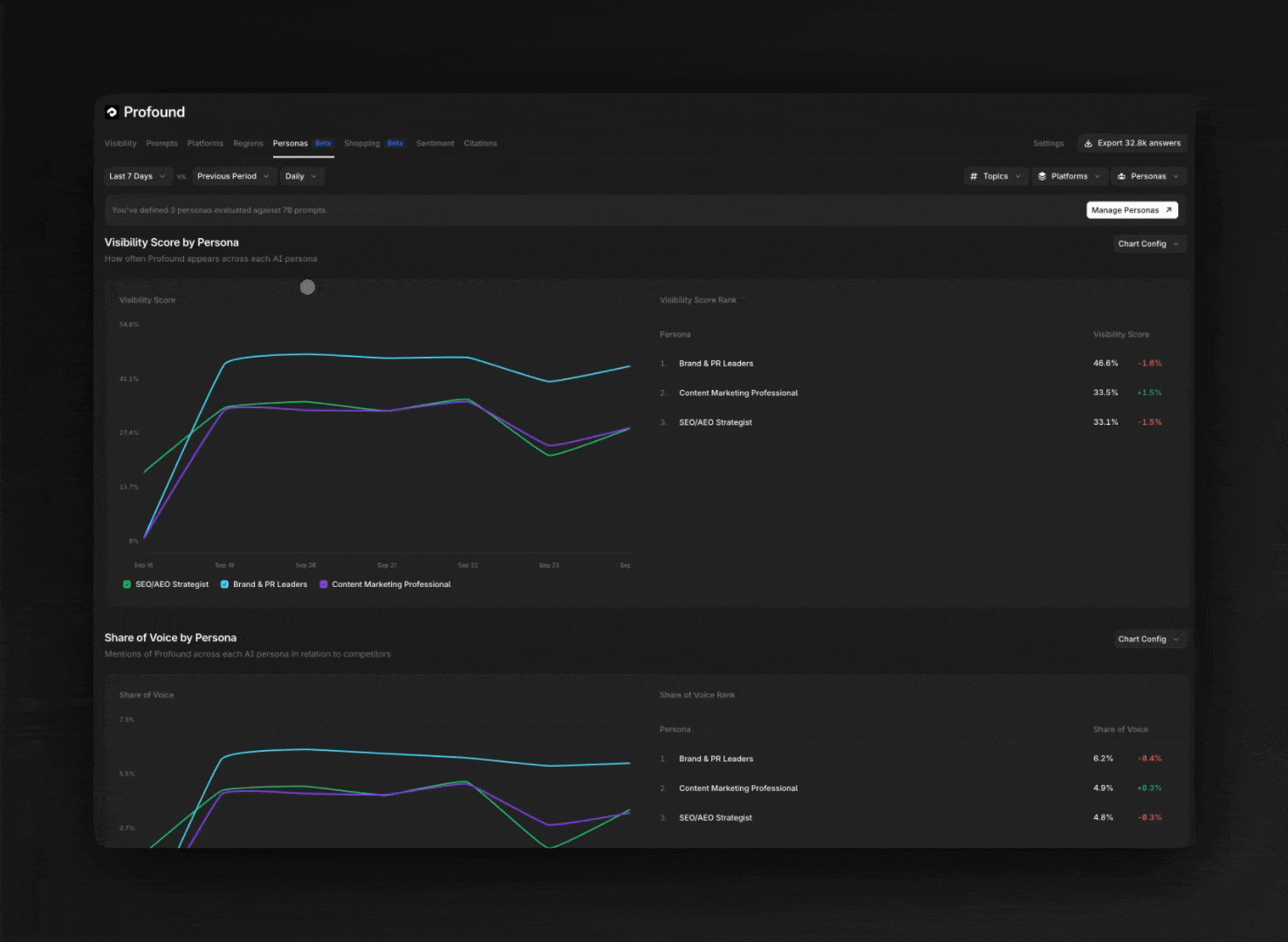
Profound treats personas as a first-class dimension, letting you slice Visibility Score and Share of Voice by segments like Brand & PR Leaders, Content Marketing Professional, and SEO/AEO Strategist.
Key takeaway: Searchable only segments by geography, not persona—so if you serve distinct buyer types, you can’t tell how you show up for each. Profound lets you segment visibility by persona.
Running workflows at scale isn’t really possible in Searchable
Using Searchable’s AI chat agent and then Skills (asking it to create repeatable workflows), you can automate some repeatable tasks. But it’s built around a single conversation. A Skill lets you save a workflow and run it again, but each run happens in that one chat window. There’s no way to run the same workflow across a whole list of pages, topics, or prompts at once.
So the moment your AEO program grows past hand-run tasks—refreshing fifty blog posts, generating FAQs across every topic, running a health report on your full prompt set—Searchable stops scaling with you.
This is where Searcheable pales the most compared to Profound. Profound Sheets lets you run Agent workflows across hundreds or thousands of inputs in parallel. Every row is its own Agent run, so a bulk blog refresh or a recurring, all-topics health report is a single operation rather than fifty manual ones.
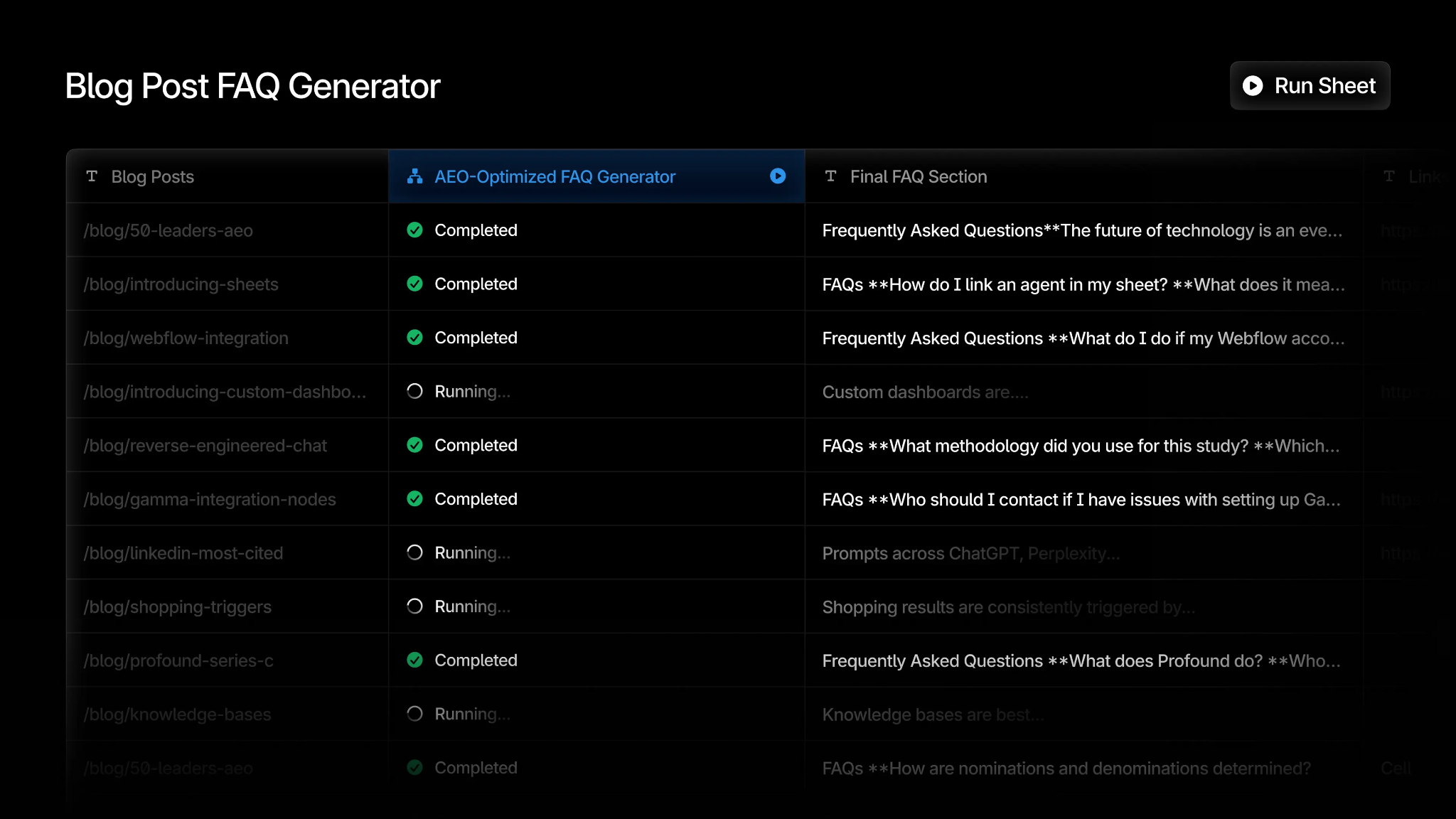
Profound Sheets runs Agent workflows across hundreds of rows at once — here generating AEO-optimized FAQs for an entire list of blog posts in a single operation instead of one at a time.
Key takeaway: Searchable’s workflows run one at a time in a single chat window, so there’s no real way to execute them in bulk. Profound’s Sheets runs the same workflow across hundreds of inputs at once, which is what scaling an AEO program actually requires.
Bottom line: Is Searchable the right choice for you?
Searchable is the right choice if you:
- Track mainly ChatGPT, Google AI Overviews, and Perplexity
- Are starting to explore AEO and want an accessible, low-risk entry point
- Are an agency that wants to pitch AEO services to prospects without burning your clients’ tracked prompts
But Searchable is likely to fall short if you:
- Need prompt volume data to understand which AI queries actually matter for your brand
- Want to compare your visibility across LLMs side by side
- Serve distinct buyer personas and need visibility segmented by them
- Plan to run AEO workflows at scale—bulk content refreshes, all-topics health reports, and the like
- Track buyers who live on Claude, Copilot, or Grok, where add-on costs stack up fast
If you need deep, actionable AI visibility data with real prompt volume data, persona-level segmentation, side-by-side engine analysis, and agentic workflows that run at scale, Profound is purpose-built for that.
Try for free today to see how Profound—the agentic marketing platform for the era of AI—helps you move from monitoring your AI visibility to improving it.
Frequently asked questions (FAQs)
How is Searchable different from a traditional SEO tool?
Traditional SEO tools measure how you rank on Google's blue links; Searchable measures how you show up inside AI-generated answers on ChatGPT, AI Overviews, and Perplexity. The distinction matters because AI answers pull from sources differently than search rankings—though Searchable's volume and difficulty scores still lean on SEO-style estimates rather than measured AI demand.
Does Searchable track competitor visibility?
Yes. Searchable’s ranking view shows your brand alongside competitors for a given engine, so you can see who's winning the answer for a prompt. What it won't do is let you compare that competitive picture across multiple engines at once, or slice it by buyer persona.
Can Searchable improve your AI visibility, or does it only monitor it?
Searchable leans toward monitoring AI visibility, with content generation and an AI agent layered on top to help you act on what you find. Teams building a serious AEO program tend to outgrow that once they need to run fixes in bulk, such as refreshing content, generating FAQs, or running health reports across a full prompt set.
Searchable vs. Profound: Which AI visibility tool should I choose?
Searchable is a strong, affordable entry point if you mainly track ChatGPT, AI Overviews, and Perplexity and are just starting with AEO. Profound is built for deeper, ongoing work. It offers real prompt volume data, persona-level segmentation, side-by-side engine comparison, and workflows that run at scale, which is where teams tend to land as their AI visibility program matures.

