
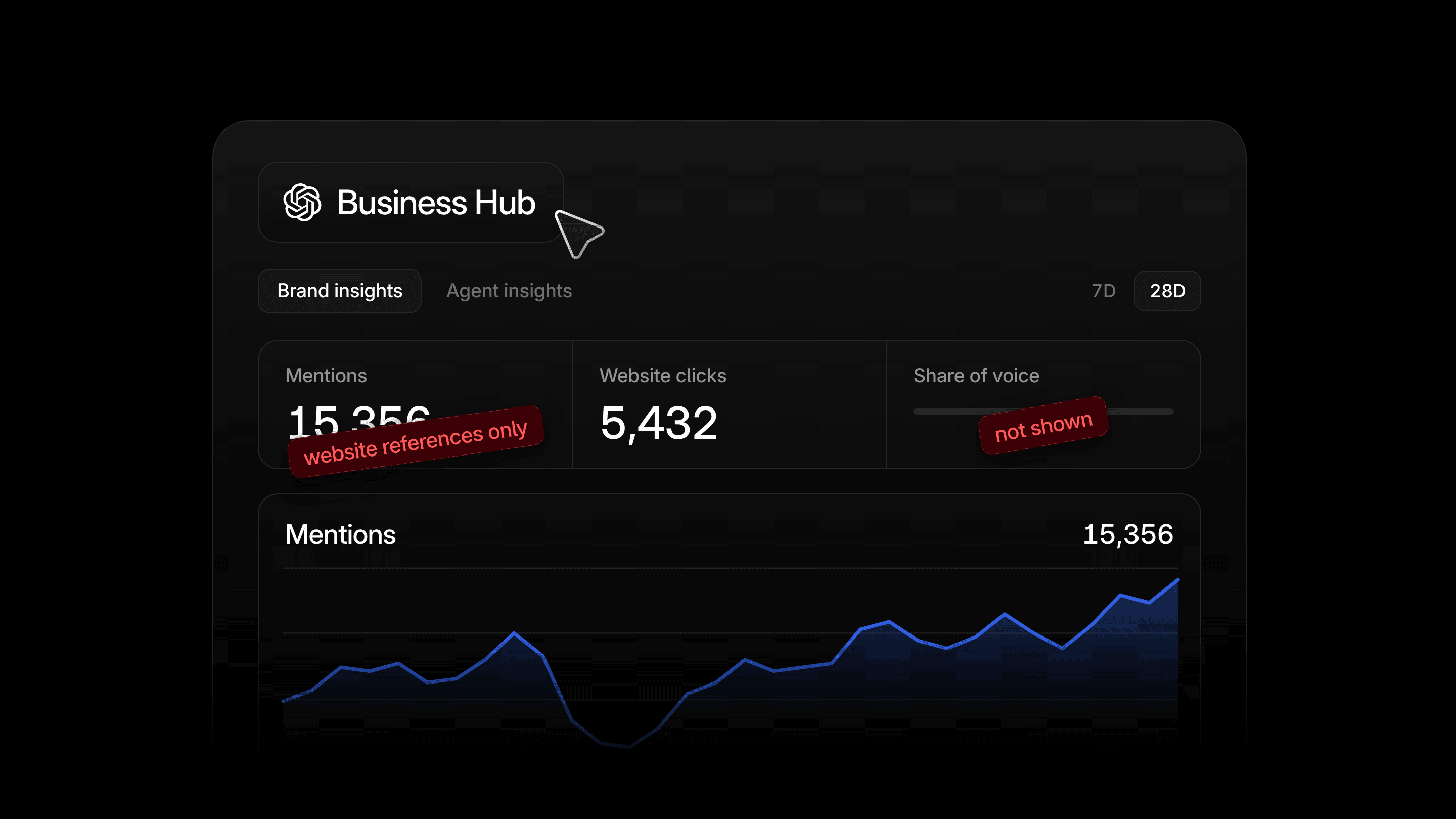
OpenAI launched Businesses in ChatGPT in beta this week, and someone at your company is about to ask what your numbers are.
This post covers what Business Hub shows, what each number counts, where the limits are, and what I'd do with it.
If you run a marketing team, you finally have a number from the source to put in front of your CFO. I'm glad it exists.
However, every marketer is about to start quoting their ChatGPT "mentions", and OpenAI's definition is actually far narrower than what you and I mean by the term.
Here's how OpenAI defines each number:
Sources: OpenAI Help Center and OpenAI's launch post.
What counts as a mention?
OpenAI's setup guide defines a mention:
- For an online business: as ChatGPT referencing its website
- For a local business: as ChatGPT showing a result for that location
That's it as of now.
In my opinion that definition is extremely narrow, too narrow to be called "mentions" at all: if ChatGPT recommends your brand by name and never references your website, the Hub counts nothing.
Ask a marketer what a mention is and you'll hear the obvious answer, which is any time an answer names the brand. That's what I mean by a mention, and I'd guess it's what you mean too.
So read the Hub's "mentions" as website references, because that is what OpenAI is counting, and expect the number to come in below how often ChatGPT talks about you.
These are the two main implications of the way OAI is defining this:
- If you sell through retailers, you should expect the Hub to undercount you, because ChatGPT can recommend a product by name and point the link at a retailer, in which case the retailer gets the mention while the brand gets nothing
- The count also moves whenever OpenAI changes how it links, and we've seen it swing massively, both up and down, which means ChatGPT's linking behavior is going to have a ton of impact on your KPIs for now:
- On May 7, 2026, brand names became hyperlinks overnight: the share of ChatGPT responses containing a URL went from about 4.5% to about 20–24% in our data. Nothing about those brands changed, but a count built on website references would have jumped anyway
- In October 2025 it went the other way: ChatGPT named about 3–4 brands per response, down from about 6–7, and more than 85% of brands lost visibility
What do website clicks measure?
When someone clicks a link to your site in a ChatGPT answer, that one click can be counted in two places:
- In ChatGPT, at the moment of the click: this is the number the Hub shows you
- On your site, once the page loads and your analytics works out where the visitor came from: this is the number you've had until now
The Hub's click count is new, and for counting clicks it's the more dependable of the two, because your analytics mostly relies on a tag that ChatGPT adds to the link to know a visitor came from ChatGPT, and that tag is ChatGPT's to add or drop.
Last month we tracked the share of ChatGPT answers whose cited links carried the utm_source=chatgpt.com tag:
- About 99% before October 8
- About 5–12% on October 14
- Back to about 99% by October 16
People still clicked and still arrived during that stretch, but an untagged visit can lose its ChatGPT label in your analytics, so your reports can show a drop that never happened, and the Hub's count doesn't depend on the tag.
The Hub's click count has a limit of its own, and OpenAI says so itself: a recorded click doesn't confirm a visit or a conversion, because the click is logged in ChatGPT and the visit happens on your site.
Both numbers share a bigger limit, which is that they only count people who click, and plenty of people who see your brand in an answer never click and come to you later some other way.
In a US panel of more than 2 million conversations
- A brand mention in ChatGPT lifted seven-day site visits by about 2 points
- More than 97% of those visits carried no UTM
- Only 42% of first visits came within 24 hours
A separate study of 221 shopping tasks found that 92.8% ended with no meaningful click to the open web.
So I treat any click count, the Hub's or my own, as the least ChatGPT is sending me.
What do Business Hub analytics leave out?
OpenAI's documentation says little about the rest of the dashboard
- Insights cover the past 28 days in aggregate.
- Figures appear only when enough conversations clear a threshold that OpenAI does not publish, so a blank is not a zero.
- Discovery topics are common themes across conversations where your website was cited.
- You won't find prompts, conversation text, competitor data, or share of voice, and the documentation describes no export or API.
- Plenty of companies can't sign up yet either: at launch the flow offers a physical location or an online store, with the service business type marked as coming soon, which leaves out most SaaS companies.
On the denominator, the Hub tells you how many times your site was referenced, but it doesn't tell you how many conversations in your category that was out of, or how many of those went to a competitor.
As an example: knowing you were mentioned 100,000 times sounds good until you learn a competitor was mentioned 400,000 times, and the dashboard would show you only the first figure.
The tide is rising under every brand at once: commercial conversations grew from 13.9% to 19.2% of ChatGPT conversations in a year, so a brand can post a higher count every month and still be losing share.
I'm wary of the 28-day window as well, the median page loses half its citation share 11 days after it peaks.
Business Hub only covers ChatGPT
Every count in Business Hub (mentions, clicks, topics) comes from ChatGPT alone, so it can't tell you how you're doing in Claude, Gemini or Google's AI results, and those engines behave very differently:
- ChatGPT and Claude rarely cite the same places: they share about 8% of cited domains, and Claude overlaps 64% with Google's results against 37% for ChatGPT (State of AEO 2026).
- They cite different kinds of pages too: 51.8% of ChatGPT's citations go to a brand's own pages, against 31.3% for Google AI Mode and 29.0% for Claude (The New Citation Economy).
- Claude leans on evaluative content: listicles, comparisons, research and explainers are 64.9% of its citations, against 33.5% for ChatGPT and 24.1% for Google AI Mode.
- Inside Google alone, Gemini, AI Overviews, and AI Mode share about a third of the companies they name, and the median brand has an 8-point visibility gap between its best and worst of the three.
- The rise and fall of a page's citations barely correlates across engines: 0.03 to 0.09.
So the same brand can look strong in Business Hub and be missing in Claude or Gemini, and nothing in the Hub will show you that.
Use the Hub for what happened, and prompt tracking for why
The Hub tells you what happened in ChatGPT: how often your site was referenced and how many clicks followed, counted by OpenAI from conversations that took place there.
It doesn't tell you why, because there are no prompts and no competitors in it.
Prompt tracking is how you get the why: you run a fixed set of prompts over and over, record every brand named and every source cited, and you can see:
- Which questions you lost
- Who took the slot
- Which source changed
The two will never show the same number, and that's fine, because they count different things:
- The Hub counts website references in conversations above a privacy threshold
- Prompt tracking counts every brand mention across a defined prompt set
They should move in the same direction, though, and that gives you an outside check on your own work: if your tracked visibility climbs for two months and the Hub stays flat, look at your prompt set as an example. It can also mean ChatGPT is naming you more without referencing your site, or that OpenAI changed something, so check those too.
What I would do now
- Claim your business and finish identity verification: insights do not appear until both steps are done.
- Pick a fixed day each week and write down mentions, clicks, and topics yourself, because the window rolls and no export is documented (yet).
- Put Hub clicks next to tagged ChatGPT sessions in your analytics: the difference is a mix of lost attribution and clicks that never became visits; either way you learn something.
- Keep a log of ChatGPT product changes on the same timeline, since link behavior changed in May and tagging changed in October, and both would have moved these numbers.
- Call the number "ChatGPT website references" in reports: "AI visibility" overstates it, since the Hub covers one engine and one kind of mention.
- Use it to test your prompt set, if the two trends disagree for long, find out why.
This will get better, and it still won't answer everything
I'm not naive about where this goes: the Hub will get better and there will be more data in it. OpenAI has already launched agents that let an eligible business answer customer questions right inside ChatGPT, and I'd bet first-party counts make revenue attribution easier over time.
But I'm not naive the other way either: Google Search Console tells you about your own site, and marketers still use other tools alongside it, because you want to know about the whole market and not only your own brand, and there will always be things first-party data won't show you.
So I wouldn't treat today's Hub as the permanent state of the industry, and I wouldn't expect any future version of it to answer every question.


